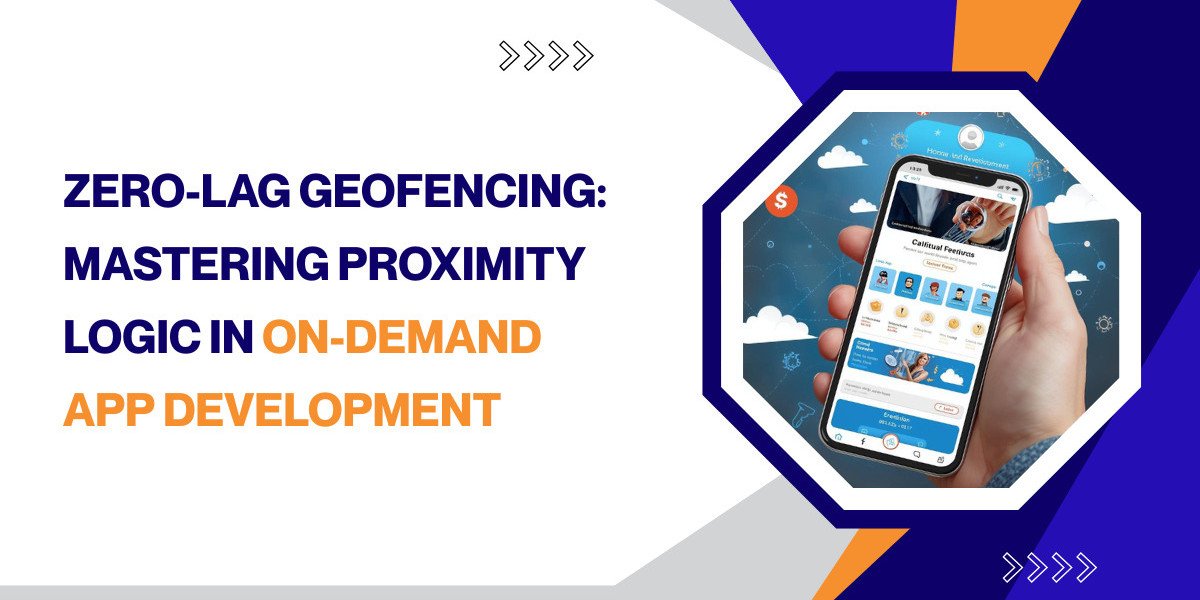

In 2026, the success of an on-demand platform depends on speed and precision. Whether delivering food, hailing a ride, or dispatching a repair technician, the app must know exactly where the user is at every second. This is where geofencing plays a vital role. Geofencing creates a virtual boundary around a specific physical location. When a device enters or leaves this zone, the app triggers an action.
The Evolution of Geofencing in 2026
Geofencing technology has matured significantly. In the past, apps relied heavily on basic GPS pings. This often drained batteries and caused delays in urban "canyons" with tall buildings. Today, the global geofencing market is projected to reach $3.92 billion in 2026. This growth is driven by the need for "Sentient Platforms"—apps that proactively adapt to user movement.
Modern On-Demand App Development now uses a hybrid approach. It combines GPS with Wi-Fi signals, cellular tower data, and Bluetooth beacons. This "Sensor Fusion" allows for accuracy within 5 to 10 meters while reducing the time it takes to trigger an event.
Technical Challenges of Traditional Proximity Logic
To solve the lag problem, we must first understand why it happens. Latency in proximity triggers usually stems from three areas:
Signal Drift: GPS signals often "jump" around, especially indoors. This causes "False Positives" where the app thinks you entered a zone when you did not.
Polling Intervals: To save battery, phones check location every 30 to 60 seconds. A fast-moving car can drive through a small geofence before the phone even checks the location.
Operating System Limits: Android and iOS limit how often apps can poll location in the background. If the app is not optimized, the OS may "kill" the location service to save power.
Mastering Zero-Lag Proximity Logic
An expert On-Demand App Development Company uses advanced logic to bypass these limits. Here are the core technical strategies used in 2026.
1. Dynamic Polling and Activity Recognition
Instead of checking location at a fixed interval, the app should adjust its "heartbeat" based on user speed.
Stationary Mode: If the phone's accelerometer detects no movement, the app stops polling. This saves nearly 90% of battery drain.
High-Speed Mode: If the user is in a vehicle, the app increases polling frequency.
Proximity Buffers: As a user approaches a geofence, the app "wakes up" and prepares to trigger.
2. Edge-Side Triggering
Traditionally, the phone sends its coordinates to a server. The server then checks if the user is in the zone and sends a command back. This creates a "round-trip" delay.
Local Processing: Modern apps download geofence coordinates to the device itself.
Zero-Trip Logic: The device evaluates the proximity logic locally. The action triggers in milliseconds without waiting for a server response.
3. Predictive Pathing
In 2026, we use AI to predict where a user will be in the next 30 seconds.
Heading Analysis: If a delivery driver is moving north at 30 mph, the system predicts their arrival at the next geofence.
Pre-fetching: The app pre-loads the "Arrival" screen and notification content before the driver even crosses the line.
Battery Optimization: The Silent Competitor
You cannot have zero-lag if the user uninstalls your app because it kills their battery. On-Demand App Development requires a delicate balance.
Tracking Method | Accuracy | Battery Impact | Best Use Case |
Continuous GPS | 3-5 Meters | High (30-50%) | High-precision navigation. |
Hybrid Geofencing | 10-50 Meters | Low (5-10%) | Store arrivals and check-ins. |
Cell ID Tracking | 500+ Meters | Minimal (<1%) | General city-level awareness. |
Bluetooth Beacons | <1 Meter | Medium (15-25%) | Indoor navigation and micro-targeting. |
Recent studies show that using geofencing instead of continuous tracking can improve device uptime by up to 25%. A top On-Demand App Development Company will always prioritize OS-level geofencing APIs (like Google’s GeofencingClient) because they are highly optimized for power.
High-Precision Use Cases for 2026
Zero-lag geofencing is essential for specific industries. Here are examples of how experts implement this logic.
1. Last-Mile Delivery
When a courier is 100 meters away, the app triggers a "Meet your driver" notification. If there is a 20-second lag, the driver might already be at the door, causing a delay in the hand-off. Zero-lag ensures the customer is ready the moment the wheels stop.
2. Automated Check-ins (SaaS and Enterprise)
Many field service apps use geofencing for payroll. A technician enters a job site, and the app "clocks them in" automatically.
Dwell Time Logic: To prevent "buddy punching" or accidental check-ins while driving past, the system requires the user to stay in the zone for at least 2 minutes.
Audit Trails: The system logs the exact entry time, providing a 100% accurate invoice for the client.
3. Contactless Retail
Curbside pickup relies on precision. As a customer enters the parking lot, the store's "Order Ready" screen should light up for the staff.
Hardware Integration: Stores often use Bluetooth Low Energy (BLE) beacons at the entrance to supplement GPS. This ensures the staff knows which parking stall the customer chose.
Future-Proofing with 5G and 6G
As 5G adoption reaches 85% in major cities, latency issues are disappearing. The high bandwidth allows for "Ultra-Reliable Low-Latency Communication" (URLLC).
Millimeter Wave (mmWave): This technology provides hyper-accurate location data without relying on satellites.
Cloud-Native Geospatial Engines: Platforms like Radar or Mapbox can now process millions of geofence events per second with sub-10ms latency.
Conclusion
Building an on-demand app is a race against time. If your geofencing is slow, your entire service feels sluggish.
Minimize Passive Voice: Ensure your code is active. Use local triggers instead of waiting for the cloud.
Think Locally: Download geofences to the device to avoid network delays.
Focus on the User: A "Fast" app is an app that updates before the user asks for it.
When you choose an On-Demand App Development Company, ask about their approach to "Proximity Logic." Do they rely on standard APIs, or do they build custom hybrid solutions? The answer will determine if your app feels like a tool from the past or a leader in the 2026 economy.